CO2ol Down en co-creatie: hoe Carbon Market Watch een uniek proces van Europese beleidsco-creatie tot stand bracht
En hoe Dreamocracy Carbon Market Watch ondersteunde bij het vormgeven van de Europese financiering van koolstofdioxideverwijdering
Nu de urgentie om klimaatverandering aan te pakken toeneemt, worden koolstofdioxideverwijderingen (Carbon Dioxide Removals – CDR) een onmisbaar instrument binnen het klimaatbeleid van de Europese Unie. Het uitwerken van doeltreffende financieringskaders voor permanente verwijderingen is echter complex en vereist input van wetenschappers, beleidsmakers, het maatschappelijk middenveld en de industrie. Hier komt beleidsco-creatie in beeld: een collaboratieve benadering van beleidsontwerp.
In 2025 sloeg Carbon Market Watch (CMW) de handen in elkaar met Dreamocracy, specialisten in collaboratief beleidsontwerp, om CO2ol Down Fase 2 te leiden: een co-creatieproces gericht op het ontwikkelen van financieringsstrategieën voor koolstofdioxideverwijderingen binnen de EU.
Wat is beleidsco-creatie? En waarom is het belangrijk?
Beleidsco-creatie verwijst naar de gestructureerde samenwerking tussen diverse belanghebbenden om gezamenlijk beleidskaders te ontwerpen die robuust, inclusief en uitvoerbaar zijn. In plaats van geïsoleerd expertwerk steunt co-creatie op gedeelde besluitvorming, zodat de resultaten collectieve expertise en gedeeld eigenaarschap weerspiegelen.
Voor het complexe thema van de financiering van koolstofverwijdering is dit proces bijzonder waardevol. Met technische onzekerheden, ethische overwegingen en strategische afwegingen in het spel, stelt co-creatie deelnemers in staat om beleidskenmerken gezamenlijk vorm te geven, in plaats van deze opgelegd te krijgen door verafgelegen instellingen.
De rol van Dreamocracy was cruciaal bij het faciliteren en structureren van dit co-creatieproces. Zij hielpen Carbon Market Watch bij het organiseren van een multistakeholderdialoog en het destilleren van gedeelde inzichten die rechtstreeks bijdragen aan Europese beleidsdebatten.
CO2ol Down Fase 2: collaboratieve workshops in Brussel
Workshop 1: financieringsstrategieën op korte termijn
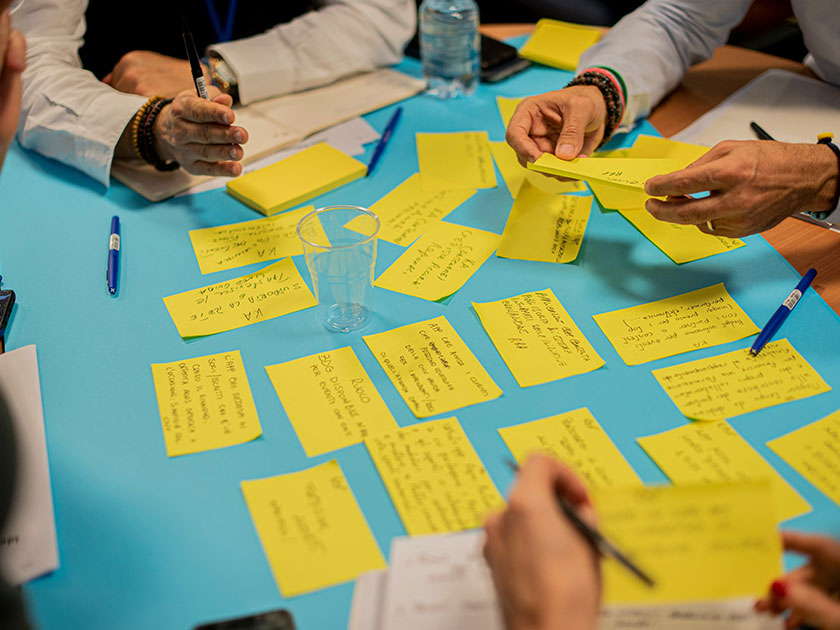
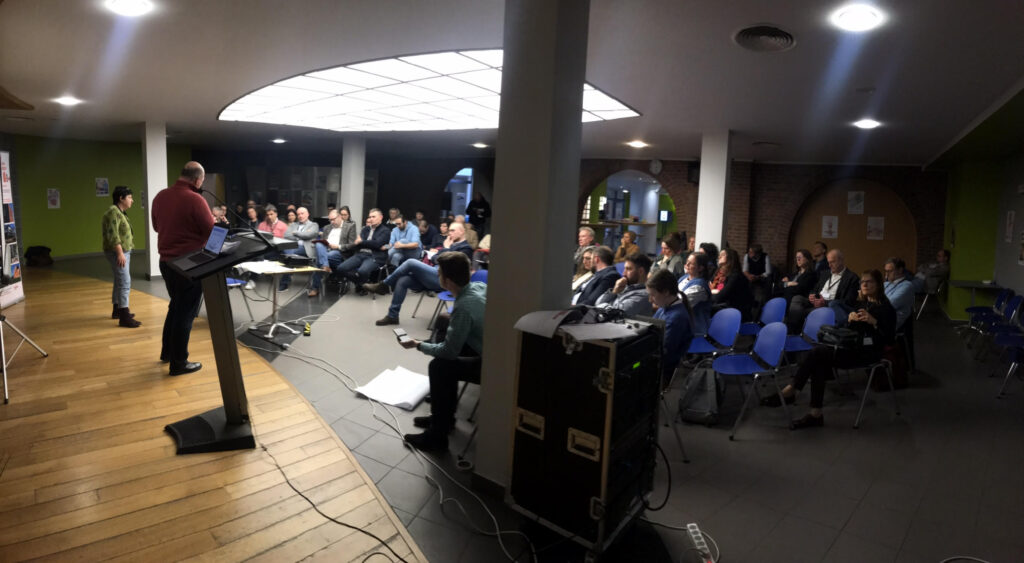
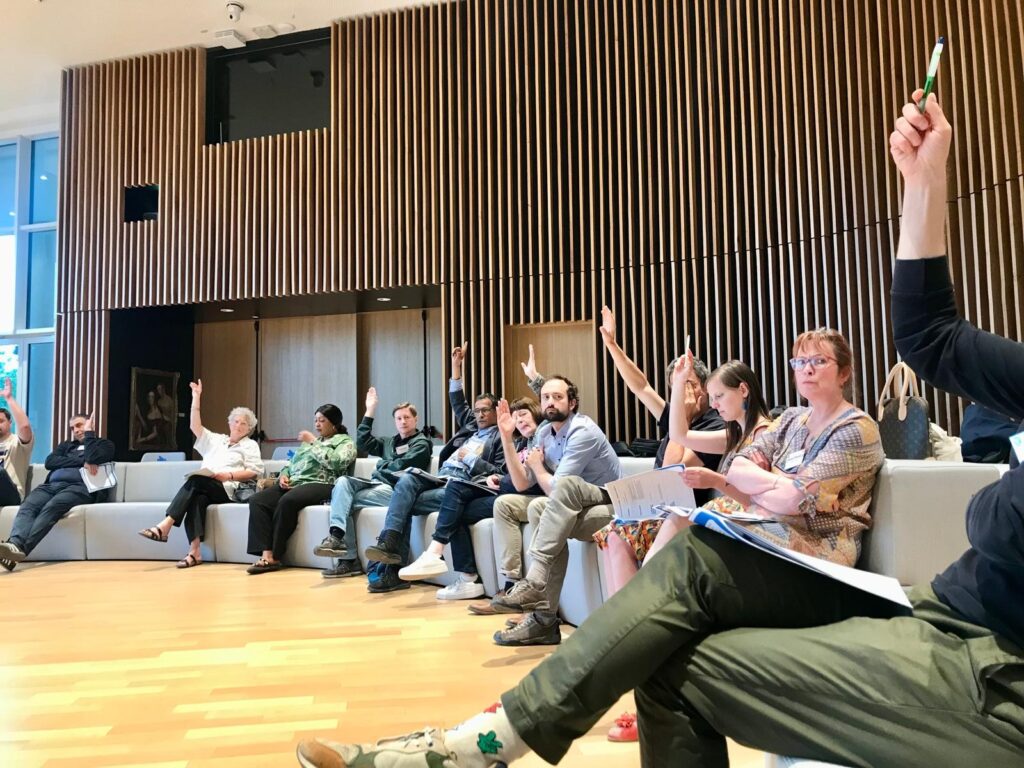
Op 22 mei 2025 ging beleidsco-creatie van start met de eerste workshop van CO2ol Down Fase 2 in Brussel. Deze sessie, georganiseerd door Carbon Market Watch en ondersteund door Dreamocracy, bracht experts uit de academische wereld, het maatschappelijk middenveld en de industrie samen om strategieën op korte termijn voor de financiering van permanente koolstofverwijderingen te bespreken.
Tijdens deze interactieve workshop:
CMW schetste de context door de belangrijkste ontwerpelementen van een Europees CDR-ontwikkelings- en uitvoeringssysteem toe te lichten, dat kan inspelen op behoeften op korte en middellange termijn.
Deelnemers discussieerden over criteria voor toegestane verwijderingsmethoden, governancemechanismen, financieringsbronnen en de politieke haalbaarheid van verschillende instrumenten.
Subgroepen verkenden principes zoals technologische maturiteit, permanentie en transparantie, die essentieel zijn voor financieringskaders met een hoge klimaatintegriteit.
Dankzij de facilitatie van Dreamocracy bleven de discussies gefocust maar flexibel, waardoor deelnemers uiteenlopende standpunten konden verkennen en tegelijk naar gemeenschappelijke grond toewerkten – een kernkenmerk van effectieve beleidsco-creatie.
Workshop 2: kader voor langetermijnimplementatie
Ongeveer een maand later, op 26 juni 2025, verschoof de aandacht in de tweede workshop naar de langetermijnimplementatie van koolstofverwijderingen.
Hier:
Legden de deelnemers principiële fundamenten voor een langetermijnfinancieringskader, met debatten over onder meer het vervuiler-betaalt-principe, klimaatintegriteit en de overgang naar een netto-negatieve economie.
Evalueerden zij drie beleidsopties: een EU-handelssysteem voor verwijderingen, uitgebreide producentenverantwoordelijkheid en doelstellingen voor permanente verwijderingen binnen een herzien EU-verdelingsmechanisme voor inspanningen.
Namen zij de rol op van EU-wetgevers in gezamenlijke redactiesessies om geloofwaardige beleidsteksten voor toekomstige nalevingsinstrumenten te formuleren.
De gestructureerde aard van deze discussies, begeleid door de expertise van Dreamocracy, zorgde ervoor dat de dialoog zowel technisch diepgaand als beleidsrelevant was, en rechtstreeks bijdroeg aan wetgevende overwegingen.
Het beleidsco-creatieproces: gestructureerd, inclusief en impactvol
Zoals uiteengezet in de regels van CO2ol Down Fase 2 bestond het co-creatieproces uit meerdere stappen:
Voorbereiding en rekrutering van deelnemers uit verschillende sectoren.
Twee volledige dagworkshops in Brussel.
Tussentijdse en post-workshop consolidatie van conclusies en ontwerpvoorstellen door een redactieraad.
Iteratieve feedbacklussen die deelnemers in staat stelden de resultaten verder te verfijnen.
Deze participatieve opzet zorgde ervoor dat de voorstellen die uit het proces voortkwamen geen loutere expertaanbevelingen waren, maar gezamenlijk gedragen resultaten – een essentieel kenmerk van echte beleidsco-creatie.
CO2ol Down Fase 2: hoe Dreamocracy collectieve intelligentie stimuleerde
Carbon Market Watch heeft bewust ingezet op het luisteren naar een brede waaier aan belanghebbenden en het integreren van hun standpunten in haar voorstellen. Binnen het Brusselse beleidslandschap is dit een bijzonder en lovenswaardig initiatief.
Door een deliberatief proces te ontwerpen met enkele kernkenmerken (zie sectie 2 hieronder) en door facilitatoren in te zetten die het proces bewaakten, maakte CMW een geïnformeerde en open dialoog mogelijk. Deelnemers konden zich vrij uitdrukken, ook wanneer zij het oneens waren.
Het ontwerp van het proces en de inhoud van de discussies werden in grote mate gestuurd door de keuzes die CMW maakte wat betreft thema’s, framing en prioriteiten.
Alle standpunten werden geregistreerd en in overweging genomen door het team van CMW, dat op basis van de ontvangen input en haar eigen visie een ontwerpdokument opstelde.
Sommige deelnemers, met name de leden van de redactieraad, kregen de kans om actief mee te schrijven aan het voorgestelde ontwerp van regelgeving.
Andere deelnemers hadden geen gelijkaardige co-schrijftaken, maar konden wel rechtstreeks commentaar geven op het ontwerp. De definitieve tekst werd samengesteld door het team van CMW en de redactieraad.
Het proces was dus in hoge mate consultatief, met duidelijke momenten en ruimtes voor co-creatie.
Wat is een co-creatief proces?
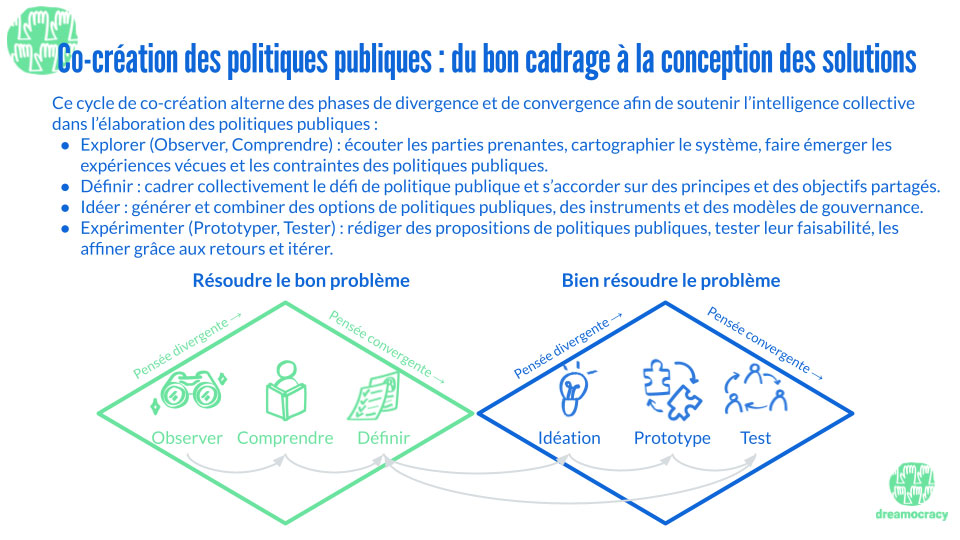
Het CO2ol Down-proces – net als andere ontwerp- en creatieve processen – maakt onderscheid tussen divergente en convergente fasen. In elke fase, sinds workshop 1, werd tijd voorzien voor beide. Opmerkelijk is dat divergentie en convergentie niet noodzakelijk lineair verlopen; men kan terugkeren naar ideeëngeneratie, zelfs wanneer al enige convergentie is bereikt. Het proces is iteratief van aard.
Als adviseurs binnen dit traject streefde Dreamocracy ernaar dit delicate evenwicht te bewaken. Kortom, om deelnemers gemotiveerd te houden en een creatieve mindset te stimuleren, wilden we ervoor zorgen dat het proces voortbouwde op wat reeds was ontstaan, terwijl er ruimte bleef voor nieuwe input en ideeën.
Verschillende elementen van het proces maakten dit mogelijk:
Het onderscheid tussen sectie 1 en sectie 2 in Ontwerp 1 en Ontwerp 2.
De mogelijkheid voor deelnemers en stakeholders om waarde toe te voegen en nieuwe opmerkingen en voorstellen te doen via commentaar.
De organisatie van een overleg tussen de redactieraad en de deelnemers vóór de finalisering van Ontwerp 2 en het Prototype.
Het opstellen van e-mails die deelname van deelnemers en externe stakeholders aanmoedigden.
Tegelijk zorgden we ervoor dat kernprincipes en kenmerken van co-creatie stevig in het proces verankerd waren, in het bijzonder:
Focus op eindgebruikers: we zorgden ervoor dat de combinatie van deelnemers en geraadpleegde externe stakeholders de diversiteit van de eindgebruikers van het financieringskader weerspiegelde.
Transparantie: transparantie is essentieel in elke fase van een dergelijk proces. We spraken af om feedback te verzamelen via commentaar op online documenten, niet via suggesties. Schone versies van de verschillende ontwerpteksten hielpen deelnemers om veranderingen duidelijk te zien.
Ondersteuning: we hielpen CMW en de redactieraad om regelmatig te communiceren met deelnemers en stakeholders, en om gemaakte keuzes en beslissingen toe te lichten.
Wat zijn de co-creatieaspecten van CO2ol Down Fase 2?
Meer specifiek werden in het ontwerp van het proces – van sessie 1 tot sessie 2, inclusief voorbereiding en opvolging – de volgende elementen gecultiveerd om van begin tot eind een echte co-creatie te bevorderen:
Gedeelde verantwoordelijkheid en gemeenschappelijk doel, met openheid om de agenda vorm te geven: het proces en elke sessie startten met een verduidelijking van intenties, werkwijzen en scope. Dit gedeelde kader werd besproken en afgestemd met de deelnemers, die werden uitgenodigd om het uit te breiden of ter discussie te stellen. Zo konden zij invloed uitoefenen op de agenda en eigenaarschap voelen.
Gedeelde principes als fundament: vóór het debat over beleidsopties kwamen de deelnemers overeen over gemeenschappelijke principes (vervuiler betaalt, klimaatintegriteit, netto-negativiteit). Deze gedeelde waarden vormden een basis voor constructieve samenwerking.
Diversiteit aan perspectieven: deelnemers kwamen uit de industrie, het maatschappelijk middenveld en de academische wereld. Deze diversiteit verrijkte het debat en voorkwam denken in silo’s.
Gestructureerde co-creatiemethoden: Dreamocracy hielp bij het ontwerp van de workshops zodat discussies verder konden gaan dan debat en uitmondden in gezamenlijke probleemoplossing. Plenaire sessies werden gecombineerd met subgroepen om dieper te graven en concrete voorstellen te doen. We besteedden bijzondere aandacht aan:
Iteratie en consolidatie Resultaten van de eerste workshop werden samengevat door een redactieraad, gedeeld met de groep voor feedback en vervolgens opnieuw ingebracht in de tweede workshop. Deze iteratieve cyclus van divergentie en convergentie staat centraal in collectieve intelligentie.
Psychologische veiligheid en vertrouwen Het format bevorderde psychologische veiligheid, met energizers en momenten om te spelen en gedachten en gevoelens te uiten. Dit gaf deelnemers het gevoel erbij te horen en ruimte om afwijkende meningen te uiten. Er werd expliciet waardering uitgesproken voor openheid en co-creatieve houding. Erkenning en vertrouwen zijn essentieel om collectieve intelligentie over meerdere sessies heen te laten groeien.
Een gedeelde informatiebasis Drie beleidsopties werden geïntroduceerd via korte presentaties, zodat alle deelnemers over dezelfde kennisbasis beschikten. Vervolgens werden deze opties gezamenlijk afgewogen aan de hand van de afgesproken principes, wat leidde tot een collectieve keuze.
Focus op korte- en langetermijnhorizonten Het opsplitsen van het werk in twee workshops (korte termijnfinanciering versus langetermijnimplementatie) hielp om complexe vraagstukken behapbaar te maken, terwijl de samenhang behouden bleef.
Kritische bespreking van haalbaarheid en principes De groep boog zich niet alleen over technische oplossingen, maar ook over politieke haalbaarheid, het vervuiler-betaalt-principe en governancestructuren. Dit verbreedde het perspectief van louter technische oplossingen naar systeemveranderingen.
Synchroon en asynchroon werken, voortbouwend op eerder werk Elke workshop begon niet van nul, maar bouwde voort op de blauwdruk van de vorige. De resultaten werden online besproken. Deze continuïteit maakte het mogelijk ideeën iteratief te verdiepen en verfijnen – een kenmerk van collectieve intelligentie.
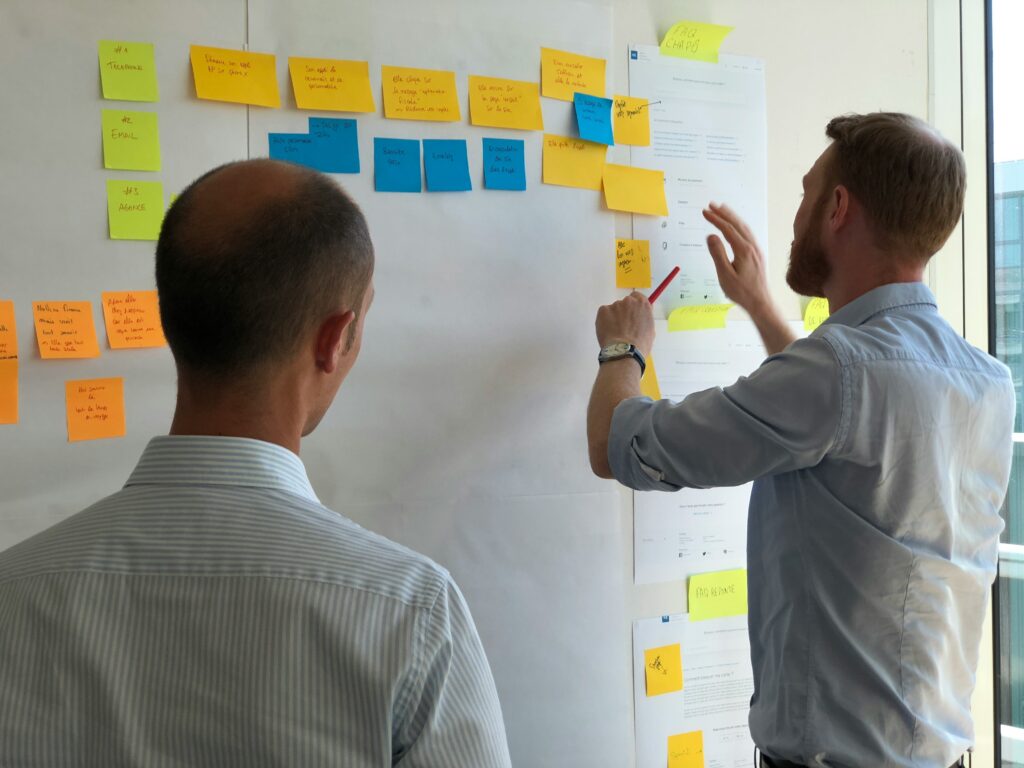
Empathie en out-of-the-box denken via rollenspel Door deelnemers “in de schoenen van wetgevers” te plaatsen en aan een ontwerpwetgeving te laten werken, verschoof de tweede sessie van abstract debat naar praktische co-creatie. Kleine groepen schreven concrete beleidsteksten, onderzochten ontwerpkeuzes en toetsten de haalbaarheid.
Synthese van divergente output Hoewel de drie groepen verschillende ontwerpen produceerden, bracht de plenaire bespreking overlappende elementen en convergentie richting gedeelde doelen aan het licht. Divergentie gevolgd door convergentie is de kern van collectieve intelligentie.
Fiat Lux! Hoe de twee sessies sterkere collectieve intelligentie losmaakten
We zagen duidelijke momenten waarop collectieve intelligentie ontstond, bijvoorbeeld:
Tijdens de eerste workshop (22 mei 2025), waar diverse experts via gestructureerde dialoog hun kennis deelden en zowel beperkingen als kansen voor de financiering van koolstofverwijdering identificeerden.
In de subgroepdiscussies, waar deelnemers gezamenlijk criteria, governance, financieringsbronnen en instrumenttypes onderzochten en rijkere, robuustere ideeën ontwikkelden dan één expertgroep alleen zou kunnen.
In de iteratieve overdracht naar de volgende sessie, waarbij resultaten werden geconsolideerd in een ontwerp dat later gezamenlijk werd verfijnd tijdens de workshop van 26 juni. Dit toont collectief leren in de tijd.
Aan het begin van workshop 2 (26 juni 2025), waar principes gezamenlijk werden vastgelegd en als kompas dienden.
In plenaire sessies, waar verschillende standpunten en ontwerpen werden vergeleken, gemeenschappelijke grond werd gevonden en een gedeeld doel ontstond.
Via het redactionele consolidatieproces, waarin output van meerdere groepen werd samengebracht in één voorstel, zodat het eindresultaat een collectief product werd en geen uitdrukking van één enkel perspectief.
Alles samen genomen was het proces dat CMW met de hulp van Dreamocracy op poten zette een intense, zorgvuldige en unieke poging binnen de Europese beleidswereld om de beperkingen van traditionele belangenafweging te overstijgen en nieuwe, convergerende beleidsopties te ontwikkelen ten bate van het Europese beleidsproces.
Wat volgt: het vormgeven van EU-beleid rond koolstofverwijdering
De resultaten van deze workshops, die momenteel door de redactieraad worden geconsolideerd, zullen worden gebundeld tot beleidsvoorstellen voor Europese beleidsmakers. In plaats van één top-down oplossing weerspiegelen deze voorstellen een gedeelde, co-gecreëerde visie op een eerlijke, effectieve en klimaatintegriteit-gedreven financiering van koolstofverwijdering.
Deze co-creatieaanpak helpt een beleidsleemte op EU-niveau te vullen door een regelgevend en financieel kader te ontwikkelen dat de klimaatdoelstellingen van de EU ondersteunt en tegelijk de complexe ethische, technische en economische uitdagingen adresseert.
Waarom dit belangrijk is voor het klimaatbeleid
Nu wereldwijde markten naar verwachting sterk zullen groeien en mogelijk miljarden euro’s per jaar zullen bereiken, is het debat over de financiering en governance van koolstofdioxideverwijdering niet langer louter academisch. Brede analyses tonen aan dat de wereldwijde markt voor koolstofverwijdering de komende jaren sterk kan uitbreiden.
Door beleidsontwerp te verankeren in co-creatie helpen Dreamocracy en Carbon Market Watch ervoor te zorgen dat nieuwe kaders inclusief en veerkrachtig zijn en meer legitimiteit genieten bij stakeholders. Deze collaboratieve dynamiek zet een krachtig precedent voor de toekomst van het klimaatbeleid in de EU en daarbuiten.
Wilt u meer weten over de methoden die in dit geval zijn gebruikt?
Cookies zijn kleine tekstbestanden die door websites kunnen worden gebruikt om de ervaring van de gebruiker efficiënter te maken. Volgens de wet mogen we cookies op uw apparaat opslaan als ze strikt noodzakelijk zijn voor de werking van deze site. Voor alle andere soorten cookies hebben we uw toestemming nodig. Deze site gebruikt verschillende soorten cookies. Sommige cookies worden geplaatst door diensten van derden die op onze pagina's verschijnen.
Noodzakelijke cookies helpen een website bruikbaar te maken door basisfuncties zoals paginanavigatie en toegang tot beveiligde delen van de website mogelijk te maken. Zonder deze cookies kan de website niet naar behoren functioneren.
Marketingcookies worden gebruikt om bezoekers op websites te volgen. De bedoeling is om advertenties weer te geven die relevant en aantrekkelijk zijn voor de individuele gebruiker en daardoor waardevoller voor uitgevers en externe adverteerders.
Met voorkeurscookies kan een website informatie onthouden die de manier verandert waarop de website zich gedraagt of eruitziet, zoals de taal van uw voorkeur of de regio waarin u zich bevindt.
Cookies, device or similar online identifiers (e.g. login-based identifiers, randomly assigned identifiers, network based identifiers) together with other information (e.g. browser type and information, language, screen size, supported technologies etc.) can be stored or read on your device to recognise it each time it connects to an app or to a website, for one or several of the purposes presented here.
Illustrations
Most purposes explained in this notice rely on the storage or accessing of information from your device when you use an app or visit a website. For example, a vendor or publisher might need to store a cookie on your device during your first visit on a website, to be able to recognise your device during your next visits (by accessing this cookie each time).
Advertising presented to you on this service can be based on limited data, such as the website or app you are using, your non-precise location, your device type or which content you are (or have been) interacting with (for example, to limit the number of times an ad is presented to you).
Illustrations
A car manufacturer wants to promote its electric vehicles to environmentally conscious users living in the city after office hours. The advertising is presented on a page with related content (such as an article on climate change actions) after 6:30 p.m. to users whose non-precise location suggests that they are in an urban zone.
A large producer of watercolour paints wants to carry out an online advertising campaign for its latest watercolour range, diversifying its audience to reach as many amateur and professional artists as possible and avoiding showing the ad next to mismatched content (for instance, articles about how to paint your house). The number of times that the ad has been presented to you is detected and limited, to avoid presenting it too often.
Number of Vendors seeking consent or relying on legitimate interest: 634
Information about your activity on this service (such as forms you submit, content you look at) can be stored and combined with other information about you (for example, information from your previous activity on this service and other websites or apps) or similar users. This is then used to build or improve a profile about you (that might include possible interests and personal aspects). Your profile can be used (also later) to present advertising that appears more relevant based on your possible interests by this and other entities.
Illustrations
If you read several articles about the best bike accessories to buy, this information could be used to create a profile about your interest in bike accessories. Such a profile may be used or improved later on, on the same or a different website or app to present you with advertising for a particular bike accessory brand. If you also look at a configurator for a vehicle on a luxury car manufacturer website, this information could be combined with your interest in bikes to refine your profile and make an assumption that you are interested in luxury cycling gear.
An apparel company wishes to promote its new line of high-end baby clothes. It gets in touch with an agency that has a network of clients with high income customers (such as high-end supermarkets) and asks the agency to create profiles of young parents or couples who can be assumed to be wealthy and to have a new child, so that these can later be used to present advertising within partner apps based on those profiles.
Advertising presented to you on this service can be based on your advertising profiles, which can reflect your activity on this service or other websites or apps (like the forms you submit, content you look at), possible interests and personal aspects.
Illustrations
An online retailer wants to advertise a limited sale on running shoes. It wants to target advertising to users who previously looked at running shoes on its mobile app. Tracking technologies might be used to recognise that you have previously used the mobile app to consult running shoes, in order to present you with the corresponding advertisement on the app.
A profile created for personalised advertising in relation to a person having searched for bike accessories on a website can be used to present the relevant advertisement for bike accessories on a mobile app of another organisation.
Information about your activity on this service (for instance, forms you submit, non-advertising content you look at) can be stored and combined with other information about you (such as your previous activity on this service or other websites or apps) or similar users. This is then used to build or improve a profile about you (which might for example include possible interests and personal aspects). Your profile can be used (also later) to present content that appears more relevant based on your possible interests, such as by adapting the order in which content is shown to you, so that it is even easier for you to find content that matches your interests.
Illustrations
You read several articles on how to build a treehouse on a social media platform. This information might be added to a profile to mark your interest in content related to outdoors as well as do-it-yourself guides (with the objective of allowing the personalisation of content, so that for example you are presented with more blog posts and articles on treehouses and wood cabins in the future).
You have viewed three videos on space exploration across different TV apps. An unrelated news platform with which you have had no contact builds a profile based on that viewing behaviour, marking space exploration as a topic of possible interest for other videos.
Content presented to you on this service can be based on your content personalisation profiles, which can reflect your activity on this or other services (for instance, the forms you submit, content you look at), possible interests and personal aspects. This can for example be used to adapt the order in which content is shown to you, so that it is even easier for you to find (non-advertising) content that matches your interests.
Illustrations
You read articles on vegetarian food on a social media platform and then use the cooking app of an unrelated company. The profile built about you on the social media platform will be used to present you vegetarian recipes on the welcome screen of the cooking app.
You have viewed three videos about rowing across different websites. An unrelated video sharing platform will recommend five other videos on rowing that may be of interest to you when you use your TV app, based on a profile built about you when you visited those different websites to watch online videos.
Information regarding which advertising is presented to you and how you interact with it can be used to determine how well an advert has worked for you or other users and whether the goals of the advertising were reached. For instance, whether you saw an ad, whether you clicked on it, whether it led you to buy a product or visit a website, etc. This is very helpful to understand the relevance of advertising campaigns.
Illustrations
You have clicked on an advertisement about a “black Friday” discount by an online shop on the website of a publisher and purchased a product. Your click will be linked to this purchase. Your interaction and that of other users will be measured to know how many clicks on the ad led to a purchase.
You are one of very few to have clicked on an advertisement about an “international appreciation day” discount by an online gift shop within the app of a publisher. The publisher wants to have reports to understand how often a specific ad placement within the app, and notably the “international appreciation day” ad, has been viewed or clicked by you and other users, in order to help the publisher and its partners (such as agencies) optimise ad placements.
Number of Vendors seeking consent or relying on legitimate interest: 634
Information regarding which content is presented to you and how you interact with it can be used to determine whether the (non-advertising) content e.g. reached its intended audience and matched your interests. For instance, whether you read an article, watch a video, listen to a podcast or look at a product description, how long you spent on this service and the web pages you visit etc. This is very helpful to understand the relevance of (non-advertising) content that is shown to you.
Illustrations
You have read a blog post about hiking on a mobile app of a publisher and followed a link to a recommended and related post. Your interactions will be recorded as showing that the initial hiking post was useful to you and that it was successful in interesting you in the related post. This will be measured to know whether to produce more posts on hiking in the future and where to place them on the home screen of the mobile app.
You were presented a video on fashion trends, but you and several other users stopped watching after 30 seconds. This information is then used to evaluate the right length of future videos on fashion trends.
Number of Vendors seeking consent or relying on legitimate interest: 634
Reports can be generated based on the combination of data sets (like user profiles, statistics, market research, analytics data) regarding your interactions and those of other users with advertising or (non-advertising) content to identify common characteristics (for instance, to determine which target audiences are more receptive to an ad campaign or to certain contents).
Illustrations
The owner of an online bookstore wants commercial reporting showing the proportion of visitors who consulted and left its site without buying, or consulted and bought the last celebrity autobiography of the month, as well as the average age and the male/female distribution of each category. Data relating to your navigation on its site and to your personal characteristics is then used and combined with other such data to produce these statistics.
An advertiser wants to better understand the type of audience interacting with its adverts. It calls upon a research institute to compare the characteristics of users who interacted with the ad with typical attributes of users of similar platforms, across different devices. This comparison reveals to the advertiser that its ad audience is mainly accessing the adverts through mobile devices and is likely in the 45-60 age range.
Number of Vendors seeking consent or relying on legitimate interest: 634
Information about your activity on this service, such as your interaction with ads or content, can be very helpful to improve products and services and to build new products and services based on user interactions, the type of audience, etc. This specific purpose does not include the development or improvement of user profiles and identifiers.
Illustrations
A technology platform working with a social media provider notices a growth in mobile app users, and sees based on their profiles that many of them are connecting through mobile connections. It uses a new technology to deliver ads that are formatted for mobile devices and that are low-bandwidth, to improve their performance.
An advertiser is looking for a way to display ads on a new type of consumer device. It collects information regarding the way users interact with this new kind of device to determine whether it can build a new mechanism for displaying advertising on this type of device.
Number of Vendors seeking consent or relying on legitimate interest: 634
Content presented to you on this service can be based on limited data, such as the website or app you are using, your non-precise location, your device type, or which content you are (or have been) interacting with (for example, to limit the number of times a video or an article is presented to you).
Illustrations
A travel magazine has published an article on its website about the new online courses proposed by a language school, to improve travelling experiences abroad. The school’s blog posts are inserted directly at the bottom of the page, and selected on the basis of your non-precise location (for instance, blog posts explaining the course curriculum for different languages than the language of the country you are situated in).
A sports news mobile app has started a new section of articles covering the most recent football games. Each article includes videos hosted by a separate streaming platform showcasing the highlights of each match. If you fast-forward a video, this information may be used to select a shorter video to play next.
Number of Vendors seeking consent or relying on legitimate interest: 634
Your data can be used to monitor for and prevent unusual and possibly fraudulent activity (for example, regarding advertising, ad clicks by bots), and ensure systems and processes work properly and securely. It can also be used to correct any problems you, the publisher or the advertiser may encounter in the delivery of content and ads and in your interaction with them.
Illustrations
An advertising intermediary delivers ads from various advertisers to its network of partnering websites. It notices a large increase in clicks on ads relating to one advertiser, and uses data regarding the source of the clicks to determine that 80% of the clicks come from bots rather than humans.
Number of Vendors seeking consent or relying on legitimate interest: 522
Certain information (like an IP address or device capabilities) is used to ensure the technical compatibility of the content or advertising, and to facilitate the transmission of the content or ad to your device.
Illustrations
Clicking on a link in an article might normally send you to another page or part of the article. To achieve this, 1°) your browser sends a request to a server linked to the website, 2°) the server answers back (“here is the article you asked for”), using technical information automatically included in the request sent by your device, to properly display the information / images that are part of the article you asked for. Technically, such exchange of information is necessary to deliver the content that appears on your screen.
Number of Vendors seeking consent or relying on legitimate interest: 522
The choices you make regarding the purposes and entities listed in this notice are saved and made available to those entities in the form of digital signals (such as a string of characters). This is necessary in order to enable both this service and those entities to respect such choices.
Illustrations
When you visit a website and are offered a choice between consenting to the use of profiles for personalised advertising or not consenting, the choice you make is saved and made available to advertising providers, so that advertising presented to you respects that choice.
Number of Vendors seeking consent or relying on legitimate interest: 522
Information about your activity on this service may be matched and combined with other information relating to you and originating from various sources (for instance your activity on a separate online service, your use of a loyalty card in-store, or your answers to a survey), in support of the purposes explained in this notice.
Number of Vendors seeking consent or relying on legitimate interest: 366
In support of the purposes explained in this notice, your device might be considered as likely linked to other devices that belong to you or your household (for instance because you are logged in to the same service on both your phone and your computer, or because you may use the same Internet connection on both devices).
Number of Vendors seeking consent or relying on legitimate interest: 517
Your device might be distinguished from other devices based on information it automatically sends when accessing the Internet (for instance, the IP address of your Internet connection or the type of browser you are using) in support of the purposes exposed in this notice.
Number of Vendors seeking consent or relying on legitimate interest: 502
With your acceptance, certain characteristics specific to your device might be requested and used to distinguish it from other devices (such as the installed fonts or plugins, the resolution of your screen) in support of the purposes explained in this notice.